

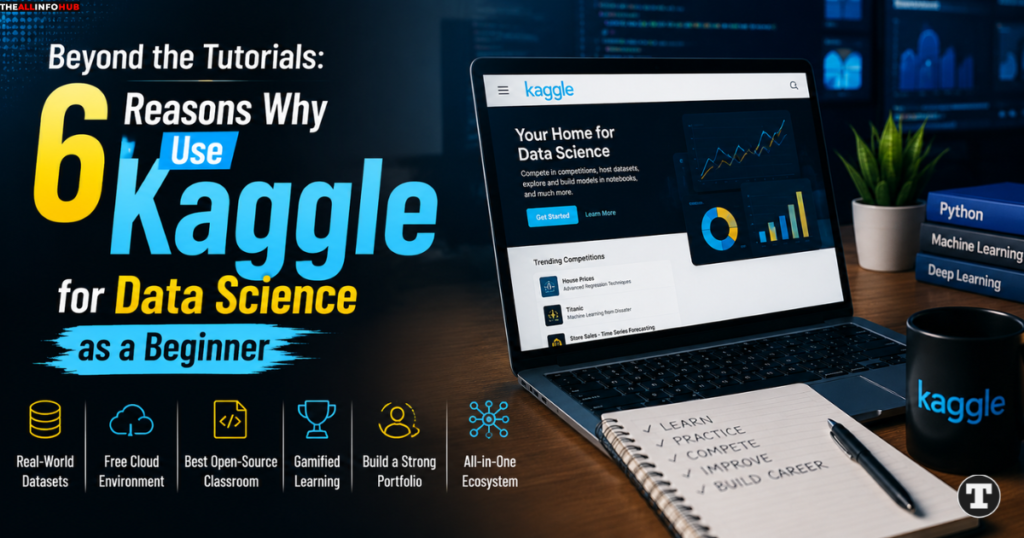
why use Kaggle for Data Science -: Starting your Data Science journey can feel incredibly overwhelming. One day you are learning Python basics, the next you are bombarded with linear algebra, calculus, and neural networks. With thousands of courses, bootcamps, and YouTube tutorials fighting for your attention, it’s easy to get trapped in “tutorial hell”—a state where you keep consuming content without actually knowing how to apply it.
If you want to break out of this loop, there is one platform you need to embrace immediately. In this article, we will break down exactly why use Kaggle for Data Science and how it can completely transform your learning curve from day one.
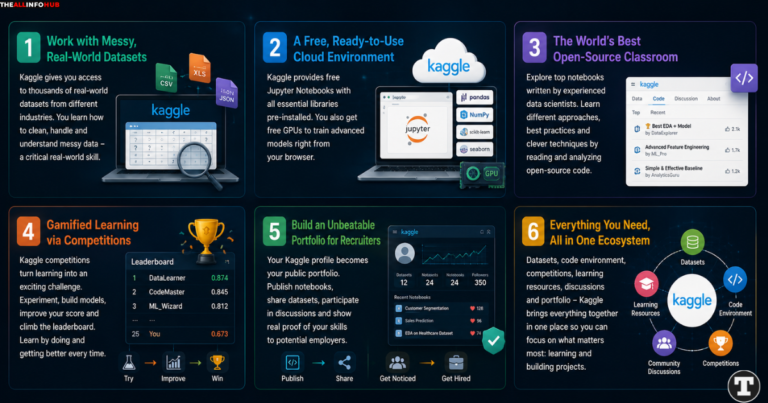
1. Work with Messy, Real-World Datasets
In textbook tutorials, data is always perfectly clean and ready for a model. But in the real world, data is chaotic.
Kaggle hosts a massive repository of thousands of public datasets spanning every industry imaginable. When beginners ask why use Kaggle for Data Science, the answer always starts with data wrangling. Working with these diverse datasets teaches you the most critical real-world skill: how to clean, reshape, and understand messy data before even touching a machine learning algorithm.
2. A Free, Ready-to-Use Cloud Environment
As a beginner, setting up your local environment (installing Python, managing Anaconda, fixing Jupyter Notebook errors) can be an absolute nightmare.
This is another huge reason why use Kaggle for Data Science. Kaggle eliminates this technical friction completely. It provides free, cloud-based Jupyter Notebooks that come pre-installed with all the essential libraries like Pandas, NumPy, Scikit-Learn, and Seaborn. Plus, you get free access to powerful GPUs, meaning you can train complex Deep Learning models right from your browser.
3. The World’s Best Open-Source Classroom
One of Kaggle’s most underrated features is the “Code” tab attached to every dataset and competition.
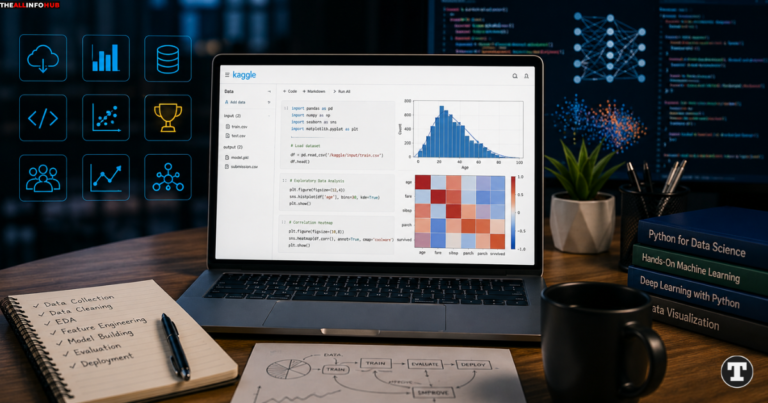
If you are still wondering why use Kaggle for Data Science when you already have video courses, think about code reviews. For any given problem, thousands of experienced data scientists share their code publicly. By exploring these notebooks, you can see exactly how experts perform Exploratory Data Analysis (EDA) and engineer features, exposing you to diverse, efficient coding styles.
4. Gamified Learning via Competitions
Nothing accelerates learning quite like a bit of friendly competition. Kaggle offers specific “Getting Started” challenges (like the famous Titanic survival prediction) designed specifically for beginners.
Participating in these challenges forces you to experiment. You’ll try one model, look at your leaderboard score, tweak your features, and try again. This iterative cycle of building, failing, and improving is the ultimate answer to why use Kaggle for Data Science instead of passively watching videos.
5. Build an Unbeatable Portfolio for Recruiters
When you are applying for your first Data Science job or internship, a resume that just says “Completed Python Course” won’t cut it. Recruiters want proof of your skills.
By publishing your datasets, writing clean notebooks, and contributing to discussions, you build a live, public profile. If a peer asks you why use Kaggle for Data Science, tell them it’s your digital resume. Showing a recruiter a Kaggle notebook where you analyzed a unique dataset is infinitely more valuable than a generic certificate.
6. Everything You Need, All in One Ecosystem
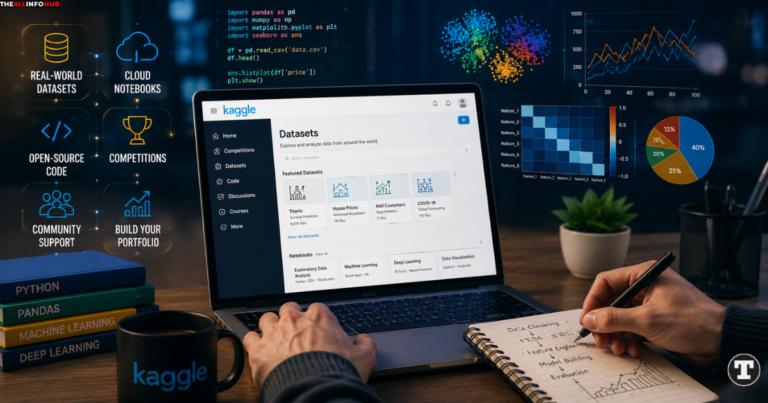
The absolute biggest advantage of this platform is that it consolidates your entire learning journey. For anyone analyzing why use Kaggle for Data Science, the sheer convenience is unmatched. You don’t need to jump between one website for datasets, another for hosting your code, a third for portfolio building, and a fourth for community forums. Kaggle beautifully combines learning, hands-on practice, live projects, and community support—all under one digital roof.
The Verdict: Stop Watching, Start Building
The secret to mastering Data Science isn’t reading another textbook or buying another 40-hour video course. The best way to learn is by building, experimenting, making mistakes, and continuously refining your process.
If you want to transition from a student to a practitioner, stop asking questions and take action. Head over to Kaggle, find a dataset that excites you, and write your first line of code today!
Have you taken the plunge into Kaggle yet? Which feature has made the biggest difference in your learning curve? Let’s talk about it in the comments below!
- You might be interested in reading this page as well
- How to Earn Money Online for Students: 5 Best Ways in 2026 -Zero Investment