
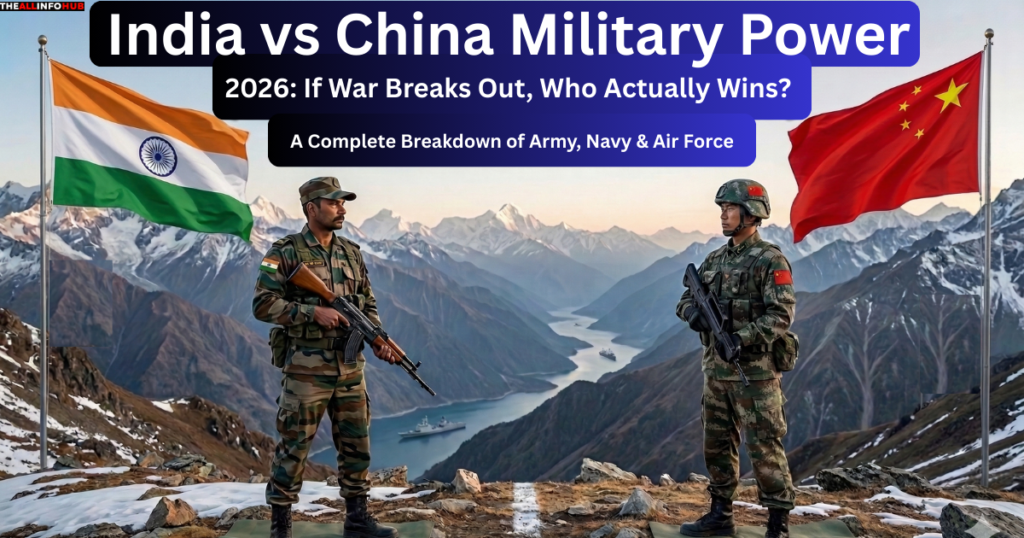
When we talk about global geopolitics in 2026, the conversation inevitably turns to Asia’s two biggest giants. The ongoing evolution of India vs China military power is not just a regional issue; it is a dynamic that shapes the future of the entire world. Both nations possess massive economies, nuclear arsenals, and over a billion people. But what actually happens when we look past the raw numbers and compare their ground realities?
In this detailed breakdown, we will compare the Indian Armed Forces against China’s People’s Liberation Army (PLA). We will look at the Army, Air Force, and Navy, and finally answer the most burning question: What would be the actual result if a war breaks out between India and China today?
1. Ground Reality: The Army Standoff
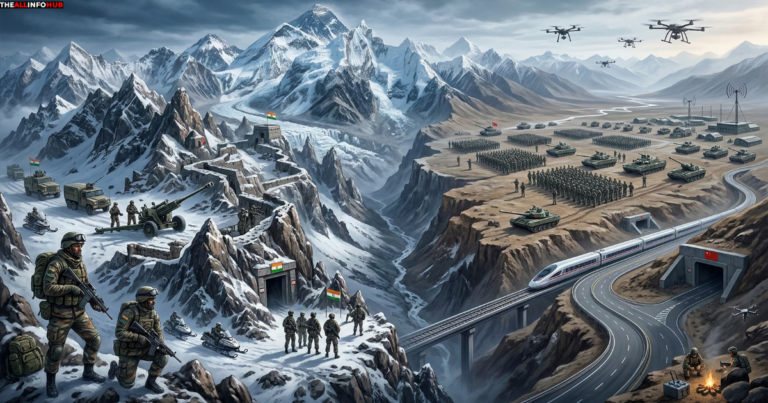
When analyzing India vs China military power, the ground forces are usually the first point of comparison because they share a massive, disputed 3,488-kilometer border known as the Line of Actual Control (LAC).
China’s PLA Ground Force (PLAGF)
The Numbers Game: China has the largest standing army in the world. They have a significant numerical advantage in terms of active troops, artillery, and armored vehicles.
Infrastructure: Over the last decade, China has built exceptional infrastructure in Tibet—highways, bullet trains, and reinforced bunkers—allowing them to move troops to the border extremely quickly.
Modernization: The PLA has heavily invested in modern combat vehicles, drones, and electronic warfare systems.
The Indian Army
Mountain Warfare Experts: The Indian Army is globally recognized as the most experienced and battle-hardened mountain warfare force in the world. Operating in extreme altitudes like Siachen and Ladakh is a daily routine for Indian soldiers.
Strategic Reposturing: By 2026, India has successfully shifted a massive chunk of its military focus from its western border (Pakistan) to its northern border (China).
The Human Element: Unlike the PLA, which relies heavily on conscripts (short-term soldiers), the Indian Army consists entirely of professional, volunteer soldiers with deep combat experience from counter-insurgency operations and previous border skirmishes.
The Verdict on the Ground: While China has more weapons and troops on paper, the Himalayas act as a great equalizer. High-altitude warfare requires physical endurance and specific experience, where India holds a distinct edge.
2. Air Force Comparison: Ruling the Skies
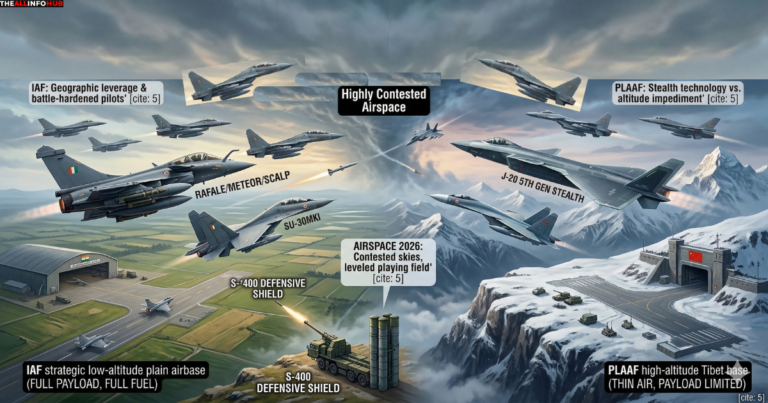
Air superiority is critical in modern warfare. The comparison of the Indian Air Force (IAF) and the People’s Liberation Army Air Force (PLAAF) presents a fascinating technological battle.
China’s PLAAF
Stealth Technology: China has a quantitative edge and boasts of its 5th-generation stealth fighter, the J-20. They manufacture their own jets and have a much larger fleet of combat aircraft.
The Altitude Disadvantage: China’s biggest weakness is geography. Their airbases in Tibet are located at very high altitudes. Because the air is thin, Chinese fighter jets cannot take off with a full load of fuel or heavy weapons, drastically reducing their combat effectiveness.
The Indian Air Force (IAF)
Strategic Base Locations: Indian airbases in Assam, Punjab, and Haryana are located at lower altitudes in the plains. This means Indian jets like the Sukhoi Su-30MKI, Rafale, and Tejas can take off fully loaded with maximum weapons and fuel.
Advanced Tech: The induction of French-made Rafale jets equipped with Meteor beyond-visual-range missiles, combined with the lethal S-400 air defense systems, gives India a massive defensive and offensive shield.
Combat Readiness: The IAF frequently trains with Western air forces (like the US, France, and UK), giving their pilots exposure to diverse and advanced combat tactics.
The Verdict in the Air: China has more planes, but India’s geographic advantage and highly trained pilots level the playing field, making the airspace highly contested.
3. Naval Strength: The Battle for the Indo-Pacific
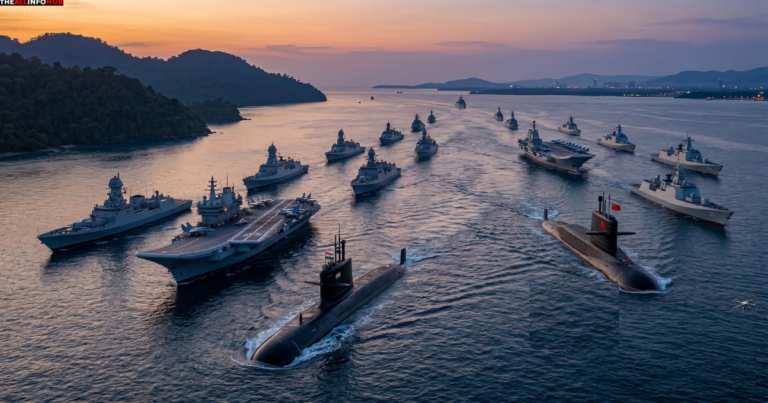
The maritime domain is where the future of India vs China military power will truly be tested.
China’s PLAN (Navy)
Massive Fleet: China currently operates the largest navy in the world by the number of ships. They are pumping out destroyers, frigates, and submarines at an unprecedented rate.
Aircraft Carriers: By 2026, China operates multiple aircraft carriers (Liaoning, Shandong, and Fujian) as they push to become a true global “blue-water” navy.
The Indian Navy
The Geographic Masterstroke: India sits perfectly at the center of the Indian Ocean. More importantly, India controls the Andaman and Nicobar Islands. These islands act like “unsinkable aircraft carriers” sitting right near the Malacca Strait—a narrow waterway through which over 60% of China’s oil and trade passes.
Quality over Quantity: The Indian Navy operates lethal stealth destroyers, Scorpene-class submarines, and two aircraft carriers (INS Vikramaditya and the indigenous INS Vikrant).
Alliances: India does not fight alone at sea. Through the Quad alliance (India, US, Japan, Australia), India has powerful partners to check China’s expansion in the Indo-Pacific.
The Verdict at Sea: China dominates the South China Sea, but if a conflict enters the Indian Ocean, the Indian Navy holds the ultimate “chokepoint” advantage.
4. What If A War Breaks Out? The Ultimate Result
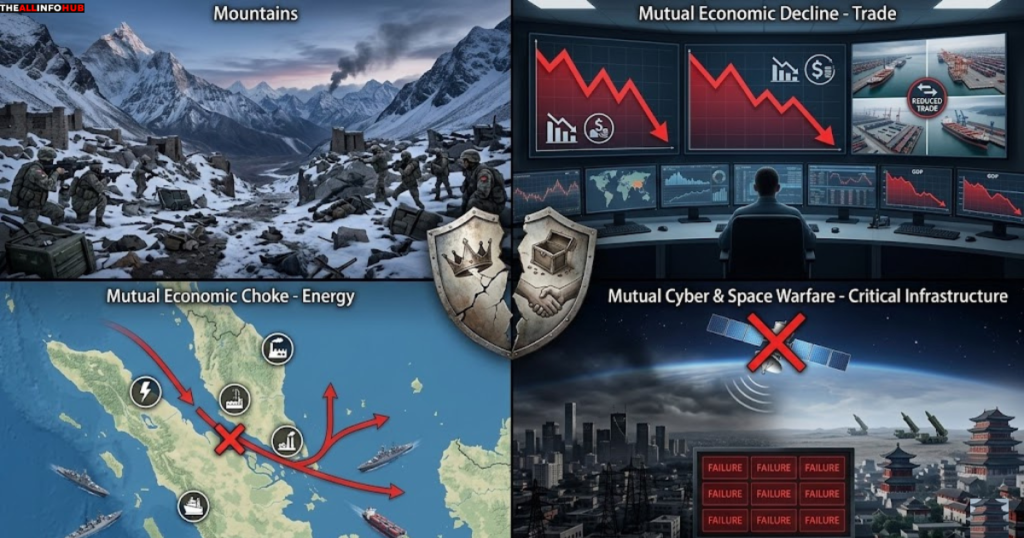
This is the question everyone asks: What is the final result if these two nuclear-armed neighbors go to an all-out war?
If we objectively analyze the India vs China military power in a real-world scenario, here is what would likely happen:
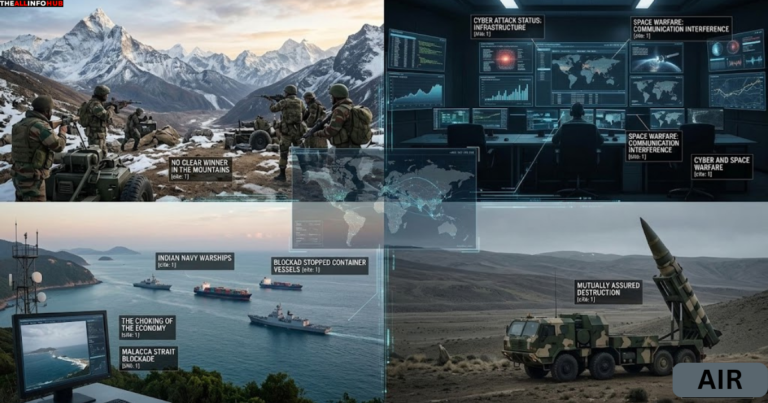
No Clear Winner in the Mountains: A massive ground invasion by either side is practically impossible. The Himalayan terrain is brutal. Capturing and holding territory at 15,000 feet requires supply lines that are incredibly easy to destroy. A ground war would result in high casualties for both sides, ending in a bloody stalemate rather than a decisive victory.
The Choking of the Economy: If a war breaks out, the Indian Navy would immediately move to block the Malacca Strait. This would instantly cut off China’s energy supplies (oil from the Middle East), bringing the Chinese manufacturing economy to a grinding halt within weeks.
Cyber and Space Warfare: Before a single bullet is fired, both nations would launch massive cyber-attacks against each other. Power grids, banking systems, and communication networks would be targeted.
Mutually Assured Destruction: Both India and China possess nuclear weapons and maintain a “No First Use” policy. Because both know that a full-scale war could escalate into a nuclear conflict, their primary goal is deterrence.
The Result: A full-scale, World War II-style war is highly unlikely. Instead, any conflict would be a localized, high-intensity border skirmish (like Kargil or Galwan), paired with massive economic and cyber warfare. Ultimately, both economies would suffer heavily, making a prolonged war a losing game for both nations.
Conclusion
Comparing India vs China military power is not as simple as counting tanks and planes. China undeniably has a larger defense budget, a massive industrial base, and superior numbers in almost every category. However, military strength is deeply tied to geography, strategy, and experience.
India’s formidable mountain troops, strategically located airbases, and total dominance over the Indian Ocean’s critical trade routes neutralize many of China’s numerical advantages. In 2026, the dragon may be massive, but the elephant stands entirely capable of defending its territory and interests. Both nations are locked in a complex balance of power where deterrence—not destruction—is the ultimate goal.
Frequently Asked Questions (FAQs)
Q1: Who has a stronger military, India or China? On paper, China has a larger and better-funded military with more ships, planes, and troops. However, in the context of a border war, India’s geographic advantages and mountain warfare expertise make it a highly balanced and formidable match.
Q2: Can the Indian Navy block China’s oil supply? Yes. A vast majority of China’s oil imports travel through the narrow Strait of Malacca. The Indian Navy, utilizing its bases in the Andaman and Nicobar Islands, is strategically positioned to blockade this route in the event of a severe conflict.
Q3: Why doesn’t China use its full air force against India? Because of the high altitude of the Tibetan plateau, Chinese fighter jets cannot take off with a full payload of fuel and missiles. Indian jets taking off from lower altitudes in the Indian plains do not face this restriction, giving India a tactical edge in the air.
Q4: Will there be a nuclear war between India and China? It is highly unlikely. Both India and China have a strict “No First Use” nuclear policy. Their nuclear arsenals exist primarily for deterrence, ensuring that neither side pushes a conventional war to the point of absolute destruction.
- You might be interested in reading this page as well
- India vs America War: Military Power Comparison & Who Would Win?